
Wholesale sourcing notes
Reading Consumer Signals While You Evaluate Fragrance Suppliers
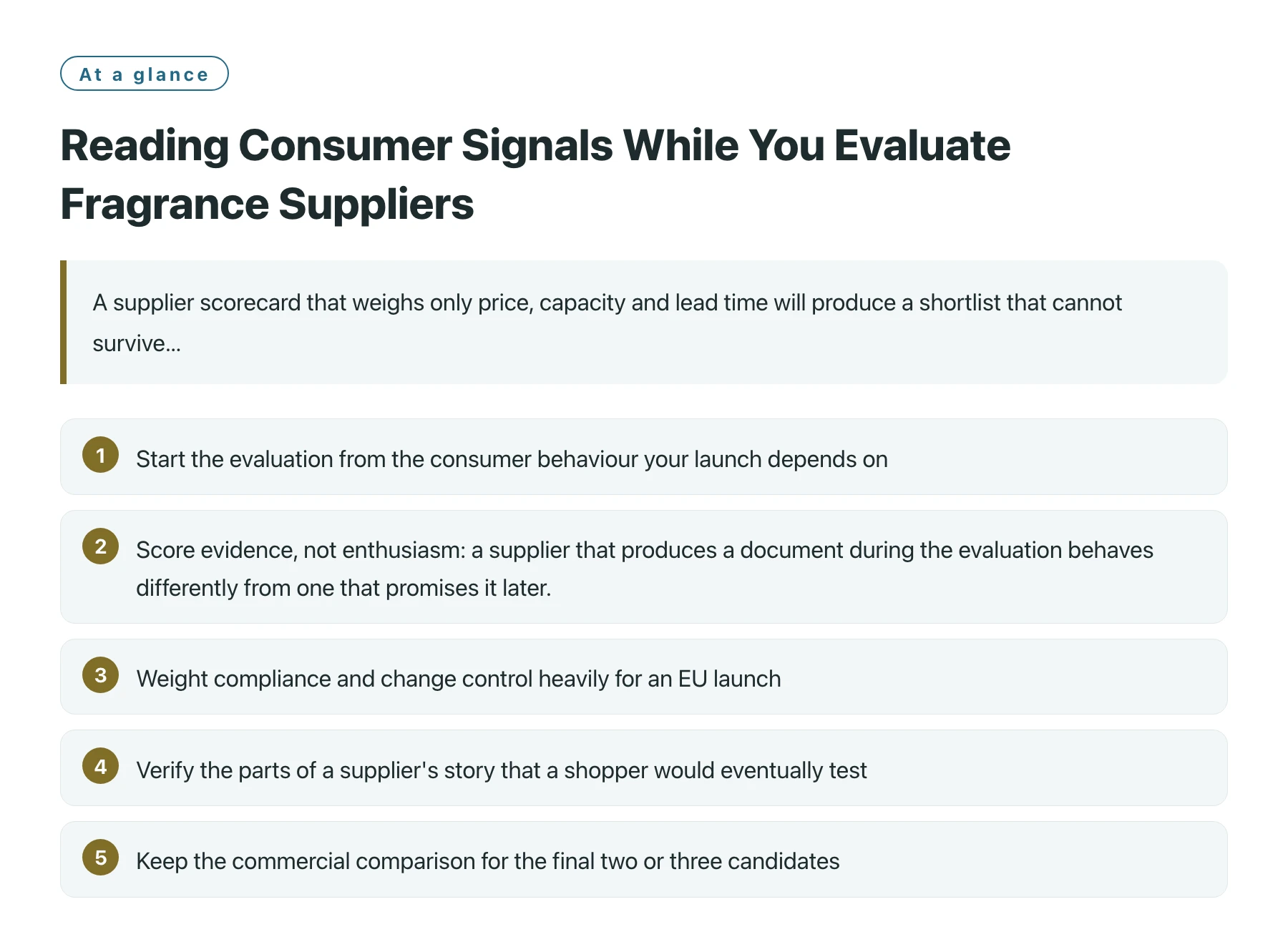
A supplier scorecard that weighs only price, capacity and lead time will produce a shortlist that cannot survive contact with an EU launch. The signals shoppers now act on, from ingredient questions to refill expectations, decide which capabilities matter before the first quotation arrives. The practical approach is to score suppliers against those signals at the shortlist stage, then score them conventionally on cost once two or three remain. Doing it the other way round locks the project into a partner who was chosen for the wrong reasons.
Key takeaways
- Start the evaluation from the consumer behaviour your launch depends on, then convert each behaviour into a capability question a supplier can answer.
- Score evidence, not enthusiasm: a supplier that produces a document during the evaluation behaves differently from one that promises it later.
- Weight compliance and change control heavily for an EU launch, because these are the areas where a cheap quotation becomes an expensive project.
- Verify the parts of a supplier's story that a shopper would eventually test, including ingredient transparency, refill or pack durability and claim support.
- Keep the commercial comparison for the final two or three candidates, so a low price cannot mask a structural gap.
- Record scores and dates, because a shortlist that is documented six months later is far easier to defend internally than a remembered impression.
Procurement teams are usually handed a specification and asked to find the lowest-priced supplier who can meet it. In fragrance, that brief is incomplete, because a large part of what makes a launch succeed is not in the specification at all. It is in whether a claim can be evidenced, whether a formula can be adjusted without restarting the qualification, and whether the partner will still be answering questions eight months after delivery.
Consumer signals are the bridge between the buyer's intent and the factory's capability. If shoppers are asking what is in the bottle, the supplier needs ingredient documentation. If they are asking what happens to the bottle afterwards, the supplier needs a pack route that supports refilling or recycling. If they are asking whether a scent lasts, the supplier needs performance testing rather than a claim.
This scorecard is written for a procurement or sourcing seat that has to defend a recommendation to a founder, a retailer or an investor. It folds those signals into the evaluation before pricing dominates the discussion, and it keeps the scoring simple enough to run across five candidates in a week.
A scorecard built from signals rather than from a specification
| Capability to score | Consumer signal behind it | What to request as proof |
|---|---|---|
| Ingredient documentation | Shoppers compare labels and ask what a material is doing in the formula | A current specification with allergen and restriction statements for a comparable product, plus the process for updating it |
| Pack and refill readiness | Durability, refillability and material choice now influence the purchase decision | A pack qualification summary and a statement of which components have been tested together |
| Claim support | Claims are checked, so unsupported wording becomes a commercial risk | A worked example of how a claim was evidenced on an earlier project, with the test or document named |
| Change control | Reformulation and pack changes happen mid-project and shoppers notice inconsistency | A written change procedure with the approval step and the revision rules for the technical file |
| Portfolio capability | Ranges now mix fine fragrance, home and body items in one launch | A category list with the filling formats the site runs in practice |
| Record of delivery | Buyers rely on the supplier's track record when the product reaches shelf | Written examples of fragrance projects with scope, volumes and pack formats described rather than images alone |
Six lines is enough for a first pass. Add lines only when they change the ranking, because a scorecard with twenty criteria will not be filled in honestly.
Turning a signal into a question a supplier can answer
Most evaluation forms fail because they ask for opinions. Does the supplier support sustainability? Is quality good? Questions like this produce answers that cannot be compared. A signal becomes useful only when it is rewritten as a request for something that either exists or does not.
Take the interest in clearer labelling. As a question, it becomes: send the specification and allergen statement for a comparable product, and describe how a formula change is reflected in the label. A supplier with a working quality system answers in a day. A supplier without one answers with a promise, and that difference is the evaluation.
The same translation works for claims about origin or method. European rules on cosmetic products, including the specific topics that govern claims and labelling, make the documentation duty concrete rather than optional [1]. A procurement manager who understands the shape of that duty can ask for the right paper at the shortlist stage instead of discovering the gap in the week before launch.
Running the evaluation in six steps
- Write the signal list firstList the three or four consumer behaviours your launch depends on, and keep the list short enough to remember in a meeting.
- Convert each signal into a document requestEvery line on the scorecard should be answerable with a file, a named test or a written procedure, never with an adjective.
- Send the same request to every candidateIdentical wording, identical deadline. Response quality and speed are themselves data points worth scoring.
- Score the evidence, not the relationshipScore what arrived and how fast, and note who answered. A supplier whose commercial contact answers technical questions is showing you the depth of its team.
- Check the story against the public recordSpend an hour reading what a supplier publishes about the company behind the factory, then check whether the evaluation answers match that account [2].
- Compare cost only among the leadersTake the top two or three scorers and compare landed cost line by line, including testing and the internal hours you will spend on document chasing.
What good evidence looks like when it arrives
A partner such as Xuelei Fragrance that develops and produces in one place can assemble a comparable record quickly, which is the behaviour a scorecard is trying to detect. A compliant specification is dated, versioned and specific to a product type. A qualification summary names the components and the test performed. A change procedure states who approves a modification and how the label follows it. A supplier that treats these documents as routine will send them without ceremony, which is exactly the behaviour you are trying to buy.
Independent testing houses describe the same picture from the laboratory side: the difference between a supplier that finds a problem and one that discovers it late is usually the routine practice of testing the finished product, not the ambition of the quality policy [3]. That is why an evaluation should ask for test records rather than for certificates, and for records on a product like yours rather than on the supplier's showpiece.
One further check is worth the effort. Ask for a short written description of what happened the last time a project went wrong, without naming the customer. Suppliers with a functioning quality system describe the mechanism and the fix. Suppliers without one describe the other party's mistake. This is also why the checks that matter before signing a contract deserve to be listed with a date against each one, so the shortlist converts into a schedule rather than a feeling.
Sources
- European Commission: Cosmetic Products — Specific Topics —— EU pages covering specific cosmetics topics such as product claims, nanomaterials and animal-testing rules.
- Cosmetics Europe —— The European trade association for the cosmetics and personal care industry, publishing guidance, positions and market information.
- SGS: Cosmetics, Personal Care & Household Testing —— Testing, inspection and certification services for cosmetics and personal care, including microbiological, stability and safety testing aligned with cosmetics GMP.
Frequently asked questions
How many suppliers should be scored in the first round?
Four to six is workable. Fewer than three removes any comparison, while more than six produces a long list of similar answers and no improvement in the decision.
Should price appear on the scorecard at all?
Not in the first round. Price is best used as a tie-breaker among the strongest candidates, because a low quotation from a structurally weaker supplier rarely survives the first compliance question.
What is the most common gap found during evaluation?
Change control. Many suppliers can produce a specification once, but far fewer can describe how it is revised when a material or a supplier changes, which is what keeps a claim true over multiple batches.
How do we evaluate a supplier's fragrance capability rather than its paperwork?
Ask for a development description of a comparable project: the brief, the directions proposed, how many sample rounds were used and how the final version was locked. That narrative reveals more than a portfolio image.
Does a long certification list settle the evaluation?
No. Certificates show which systems exist, not how they are used on your product. Ask for the record that sits behind the certificate for an item comparable to yours.
Request the sample pack
A paid swatch-and-garment set with a printed evaluation worksheet. Refundable against your first wholesale order.