
Wholesale sourcing notes
Risk Review: Screening Chinese Manufacturers for Product Fit
A factory is a good fit only when its legal identity, production process, and quality evidence line up with the product you intend to buy. Screen those points against a written specification and record open questions before comparing prices; a catalog, certificate, or video call by itself cannot establish that a manufacturer can deliver your exact order.
Key takeaways
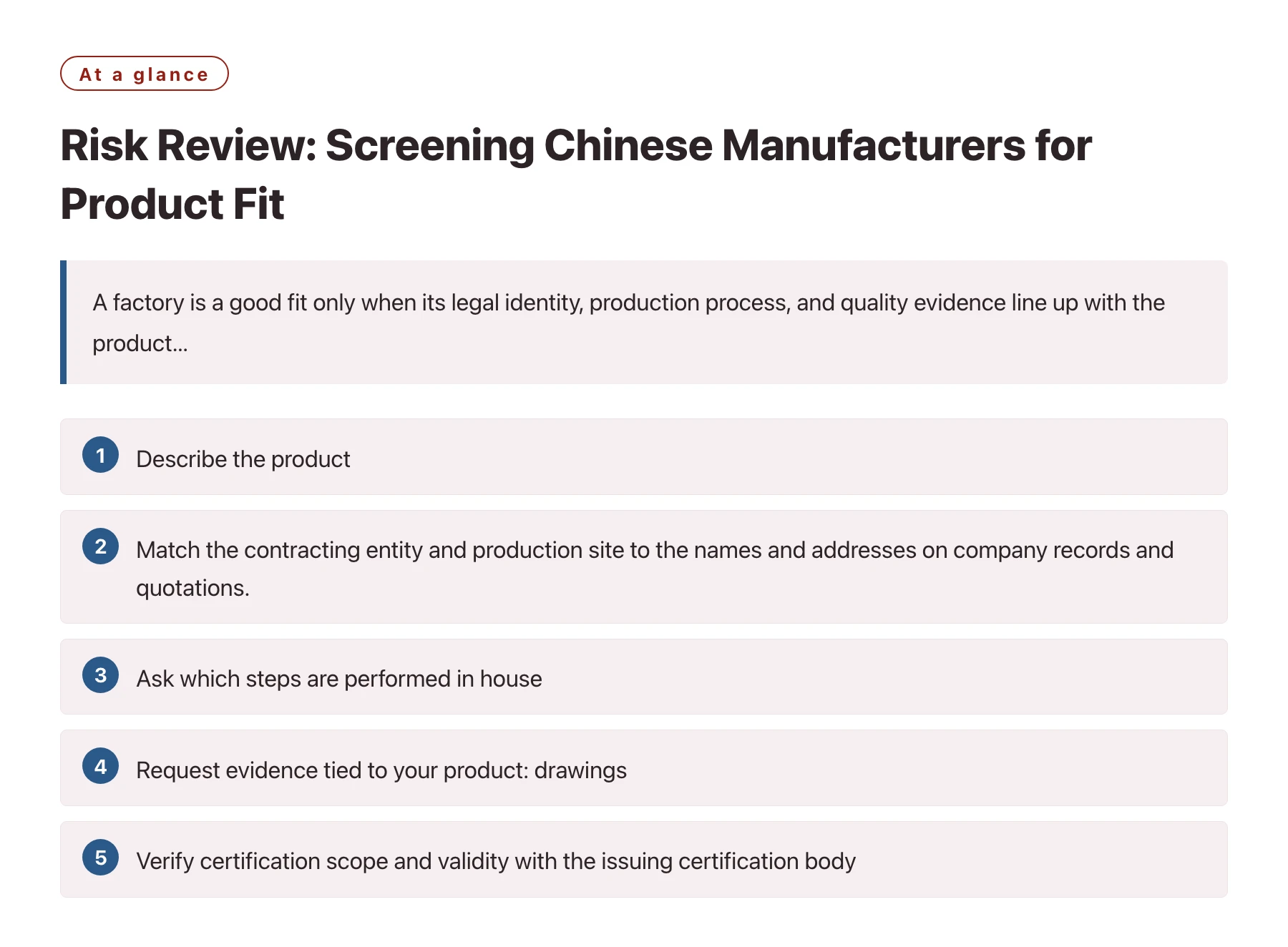
- Describe the product, materials, tolerances, packaging, and destination requirements before contacting factories.
- Match the contracting entity and production site to the names and addresses on company records and quotations.
- Ask which steps are performed in house, which are outsourced, and how changes to suppliers or materials are controlled.
- Request evidence tied to your product: drawings, sample checks, process records, and an agreed acceptance test.
- Verify certification scope and validity with the issuing certification body, then assess product requirements separately.
- Keep unresolved risks, owners, deadlines, and remedies in a decision log and the purchase documents.
Manufacturer screening is often described as a search for a factory that makes a product category. That is only the first filter. A supplier may make similar goods yet lack the equipment, process controls, capacity, material access, documentation, or export coordination needed for one particular order. A disciplined review asks what evidence would demonstrate fit, then checks that evidence before commercial urgency narrows the buyer's options.
Translate the product idea into testable requirements
Prepare a specification that a factory can quote and a buyer can inspect. Include intended use, dimensions, materials and grades, performance requirements, finish, color references, tolerances, unit packaging, master-carton details, labeling, and expected order quantities. Attach drawings, photographs, or reference samples where they resolve ambiguity, and mark which version is current. Separate mandatory requirements from preferences so a supplier cannot treat an important condition as an optional upgrade.
For each important requirement, decide how it will be checked. Appearance may be assessed against an approved sample under stated lighting; dimensions need a measurement method and tolerance; a functional feature needs a defined operating test. If the item will be sold in a regulated market, identify the applicable product rules and required records with a qualified adviser or the relevant authority. Do not assume a supplier's general quality certificate proves that a finished product meets every destination requirement.
A useful inquiry package includes the specification, target quantity, delivery window, destination, requested documents, and a clear list of questions the supplier must answer in its quotation.
Confirm the business and production identities
Ask for the full Chinese legal name, unified social credit code, registered address, production address, and the name of the entity that will sign the contract and receive payment. Compare these details across the business license, quotation, contract draft, invoice details, and bank beneficiary instructions. Differences can have legitimate explanations, such as a sales entity coordinating work at a separate plant, but the relationship and each party's responsibility should be documented before money changes hands.
China's National Enterprise Credit Information Publicity System is a government platform for company registration and other market-regulation information, including certain licensing, penalty, abnormal-operation, and serious-violation records.[1] Use it as one identity and screening source, not as a complete assessment of production quality or financial condition. Search with the legal name or unified social credit code, save the retrieval date, and ask the supplier to explain any inconsistency between the public record and the commercial documents.
Map the production route and capability gaps
Ask the supplier to walk through the route from incoming materials to finished packing. For each step, record the location, equipment or method used, responsible team, and inspection point. A process map often makes gaps visible: a supplier may assemble or pack goods but outsource tooling, surface treatment, key components, or testing. Outsourcing is not automatically disqualifying; the buyer needs to know where it occurs and how the supplier controls specifications, changes, incoming checks, and corrective action.
Connect the proposed route to your order's actual requirements. A sample made by hand may not show how a larger run will behave on a production line. A broad monthly-capacity claim is difficult to evaluate without the product mix, current commitments, staffing pattern, and bottleneck operations behind it. Ask for a capacity explanation tied to the requested configuration and schedule, and treat estimates as assumptions until milestones and evidence are agreed.
During a remote call or site visit, ask the supplier to show the relevant work area and records in sequence. Redacted examples can protect other customers' information while still showing how a control works.
Use certificates as leads for verification
Record the certificate holder, covered legal entity and site, scope, issue date, expiry date, standard, and issuing certification body. Check that the scope relates to the operations proposed for your order. A certificate for a trading office, another facility, or an unrelated activity does not answer whether the quoted factory controls the process you care about.
China's National Certification and Accreditation Administration says certification bodies must provide a way for the public to check certificate validity and make relevant certification information available.[2] Contact the issuing body or use its published lookup route when the certificate matters to your decision. Even a valid management-system certificate describes a management system within its scope; it is not a substitute for product-specific testing, material evidence, or contractual acceptance criteria.
Review samples and quality controls against the same criteria
A sample review should use the same approved specification that will govern production. Record the sample identifier, revision, materials, measured dimensions, functional results, visible defects, packaging, and any deviations accepted for evaluation. If the supplier proposes a substitute material or process, document it and decide whether it requires a new sample or test. Keep an approved reference sample or signed inspection record so that later discussions do not depend on memory or photographs alone.
Ask how incoming materials are identified, how work instructions and revisions reach operators, how in-process defects are contained, who releases finished goods, and how complaints lead to corrective action. Request records that demonstrate the controls for the product family in question, with sensitive customer details removed if necessary. A written procedure is useful, but evidence of its routine use is more relevant to assessing execution.
Choose a pre-shipment inspection or testing plan based on the consequence of a failure and the ways the product could vary. State the sampling approach, checks, test conditions, acceptance limits, and process for handling a failed result before production is complete. Inspection has a defined scope and cannot guarantee that every unit is defect-free; the contract should explain what happens when results fall outside the agreed limits.
Compare offers only after scope is aligned
Normalize quotations into comparable line items: configuration, included components, tooling, testing, packaging, labels, documentation, delivery terms, payment milestones, and exclusions. Ask the supplier to identify assumptions and quote validity. If one proposal omits a test or uses a different material, show that difference explicitly rather than treating the lower price as a like-for-like alternative.
Before selection, summarize verified facts, open questions, commercial assumptions, and risks that require a contractual control. Assign an owner and deadline to each open item. Use stop conditions for matters that cannot be offset by a lower price, such as unresolved contracting identity or missing evidence for a mandatory safety requirement. Where additional coordination is useful, compare JS Sourcing manufacturer sourcing in China support with the specific tasks your team needs, while keeping product approval and contract decisions with named decision-makers.
Sources
Frequently asked questions
Does a business registration record prove that a factory can make my product?
No. It can help verify the legal identity and show certain public market-regulation information, but production capability requires separate evidence tied to the product, process, equipment, and order conditions.
Is a valid ISO certificate enough to approve a manufacturer?
No. Check the holder, site, scope, and validity, then review product-specific requirements, process evidence, sample results, and the acceptance plan for the order.
Should I reject a supplier that outsources production steps?
Not automatically. Identify each outsourced step, the responsible party, change controls, incoming checks, and evidence that the final process meets your requirements.
What should I do if a sample differs from the production specification?
Record the deviation and do not treat the sample as approval of the written requirement. Agree whether to revise the specification, obtain a corrected sample, or reject the deviation before production.
Request the sample pack
A paid swatch-and-garment set with a printed evaluation worksheet. Refundable against your first wholesale order.